Portfolio
Projects
Pick a project to read the full case study — each card shows the theme it tackles and the skills behind it.
Case study index
SideQuest · Waste & Overconsumption
Triple R — Reduce, Reuse, Recycle
Triple R — Reduce, Reuse, Recycle
Project visual coming soon
The Challenge
Waste and overconsumption information is dense, scattered, and written for people who are already convinced. Younger and older generations learn differently — a message that lands with one can go completely unheard by the other.
What I Built
Triple R — a fold-out guide built around what each generation is already passionate about, then tied back to reducing, reusing, and recycling. Simple upcycling steps, community organizations worth recommending, and a QR code that connects readers to the creative community.
My Role
Solo project — organizational research, content simplification, layout and visual design, print production, and the moodboards behind how BKLVLUP ideas get presented.
Skills Used
Organizational Research · Simplifying Complex Information · Graphic Communication · Content Presentation
What I Learned
“Common knowledge isn't common. It's learned.”
Impact
A printed, shareable guide that catered to what each generation cares about — and a community outreach initiative connecting generations to waste management. Presented at the EcoPower '26 gallery wall and Community Report Back.
Co-Led Project · EcoPower '26 Case Study
Emergency Readiness — Community Research & Preparedness Audit
Emergency Readiness — Community Research & Preparedness Audit
Project visual coming soon
The Problem
The communities hit hardest by emergencies aren't always the ones who ignored warnings. When a major weather event hits The Flats, the people most at risk are the ones who weren't reached — by communications in the wrong language, at the wrong reading level, in a format that didn't work for how they actually get information.
Film as Qualitative Research — Thrash
We watched Thrash, a documentary about communities unprepared for flooding, and used it as a user research artifact — not just a film. We analyzed which populations were most under-informed, which warning systems failed to reach them, and which communication gaps were structural versus situational.
My Framework — The Art of the Pivot
I introduced the 'art of the pivot' as our communication audit framework: the same emergency message has to be translated not just across languages, but across learning styles, generations, and accessibility needs. A 70-year-old who doesn't use a smartphone, a parent who doesn't speak English, and a teenager who won't read a pamphlet all need different formats for the same critical information. We audited existing emergency communications through that lens and mapped where the gaps were.
Green Book Research
I contributed Green Book research for the Strengthening Communities initiative — identifying local businesses and institutions along The Flats corridors that could be designated community pact resources during a climate emergency. This feeds the Flats Rising Communication Strategy, the coordination backbone for PACT outreach built with OEM and COAD.
Field Prep & Awareness Materials
We developed and practiced canvassing scripts — tested pitches for stopping residents and explaining the Community Resilience Hub in plain language before going into the field. From the audit findings, we designed flood preparedness materials for Flats residents: what flooding looks like before it peaks, what resources exist, and what someone can do at home.
In My Words
“Green book, emergency readiness, the art of the pivot, Thrash — with watching the movie we got more intel on the under-accounted. How to translate messages, not only in different languages but different learning abilities and styles.”
Deliverables
Qualitative research analysis using Thrash as a case study for community unpreparedness · Communication audit through a multi-format, multi-generational, multi-language lens · Green Book community pact research for the Flats Rising Communication Strategy · Tested field canvassing scripts for the Community Resilience Hub survey · Flood preparedness awareness materials for Flats residents.
What's Next
The Flats Rising Communication Strategy and community pact network is live infrastructure — this research feeds directly into what BKLVLUP and Ground3D are building with OEM. The Bethany Terrace senior cooling event was planned and documented this summer. It needs a partner to activate it next season.
Cohort Project · Community & Civic Track
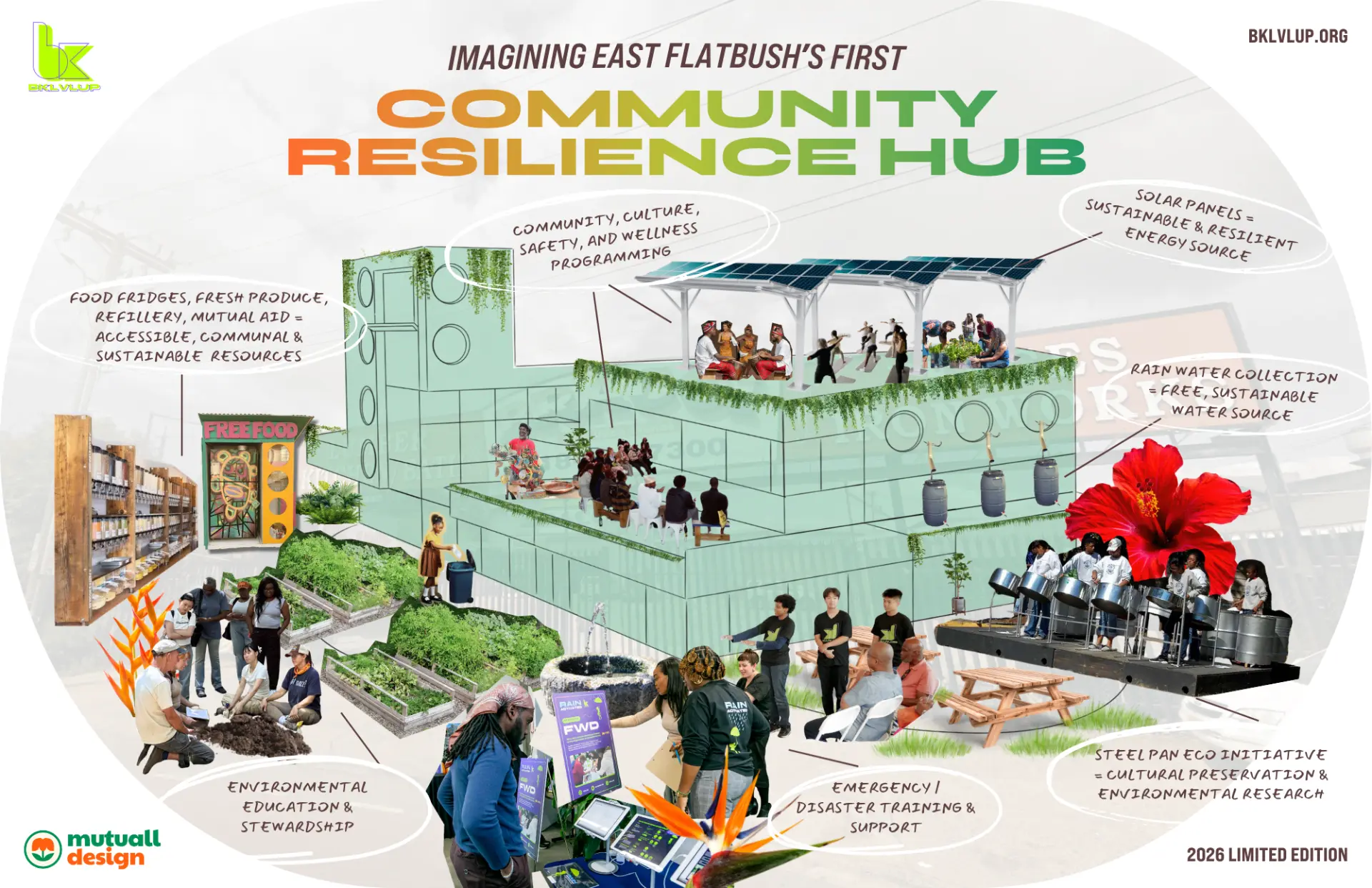
Community Resilience Hub — First Multilingual Community Survey
The Problem
Community voice was missing from the design process. BKLVLUP is building Brooklyn's first Community Resilience Hub on Utica Avenue — open year-round for emergency support, food, shelter, water, and programming. But most hub surveys are English-only, written by professionals for professionals, and never reach the people they claim to represent. Before construction, before programming, the community had to be heard.
Research Foundation
We grounded the work in the six-pillar resilience hub framework — programs and services, information and connectivity, built and natural spaces, power and backup, operations, accessibility and transportation — layered with Flats-specific data from the NYC Heat Vulnerability Index, DOH Heat Risk dashboards, and the NYS Disadvantaged Communities tool. One finding reset the whole project: heatstroke is the leading environmental cause of death for NYC seniors.
Survey Design & Deployment
BKLVLUP's first-ever Community Resilience Hub survey, built and tested in English, Spanish, and Haitian Creole by Operators who speak them — designed for reading level and format accessibility, not just translation. We gathered in-person feedback at National Night Out at the Shirley Chisholm Center, and evaluated multilingual research platforms for ongoing data collection in The Flats, piloting Google Forms as a beta.
My Role
Community & Civic track — I helped build and test the survey for real accessibility, wrote and practiced the plain-language canvassing scripts for stopping residents and explaining the hub, and prepared flood preparedness awareness materials designed for Flats residents.
In My Words
“The hub is about being ready before the emergency — and that starts with how you talk to people. If they don't understand it or trust it, the resource doesn't reach them.”
What We Built
First multilingual Community Resilience Hub survey — live in English, Spanish, and Haitian Creole · Research linking local heat vulnerability data to hub design priorities · In-person feedback gathered at National Night Out, Shirley Chisholm Center · Tested field canvassing scripts · Multilingual platform evaluation for future BKLVLUP data collection.
What's Next
The survey is live in three languages. Next is expanding in-person collection as the Hub moves from concept to construction.
Cohort Project · Community & Civic Track
The Green Book — Energy Resilience Edition
The Green Book — Energy Resilience Edition
Project visual coming soon
The Problem
What isn't documented can't be defended. The Flats holds a 40-year-old Caribbean market, a playground with roots in the 1990s, substations serving thousands of residents, green spaces, and institutions people walk past every day without knowing what they are. When gentrification comes for a neighborhood, it comes first for the things nobody wrote down.
Mapping With Ground3D
Using the Felt platform, we mapped energy infrastructure (National Grid and ConEd substations), local institutions, green spaces, historical sites, and community resources — working live and at the same time, multiple Operators dropping points and writing annotations together in one shared map. Every point was annotated in full narrative sentences, a design decision drawn from Ground3D's Roots & Rhythms map.
Street Interviews
The Community & Civic track ran street interviews near Brooklyn College. The script took rounds of practice — because, as Ground3D's Wil put it, you can't open with 'do you live here?' in New York City — and was built for youth, seniors, and longtime residents alike. I helped write the questions and filmed the track's closing video with Jay and Victoria. Three takes.
Route Fieldwork
We walked the route on foot documenting shade cover, water access, and flood risk, and began identifying corridor businesses for a community pact — places that could serve as cooling, charging, water, and information sites during a blackout or storm. This feeds the Flats Rising Communication Strategy (BKLVLUP x Ground3D x OEM/COAD).
In My Words
“It's a map you can pull up on your phone and immediately know what you actually have access to — what to use, and what to fight for.”
What We Built
Interactive GIS map of The Flats built collaboratively on Felt with Ground3D · Narrative annotations for every point, written for a self-guided tour · Street interview script and findings from the Brooklyn College corridor · Walking route assessed on foot for accessibility, shade, water, and flood risk · Published web map — The Green Book: Energy Resilience Edition, 11 stops across East Flatbush, Remsen Village & Canarsie, hosted by Ground3D.
What's Next
The map is live and published. The next phase is community pact outreach to corridor businesses willing to be designated climate emergency resources.
Cohort Project · Environmental & Data Track
Energy Clinics & the Bethany Terrace Senior Cooling Event
Energy Clinics & the Bethany Terrace Senior Cooling Event
Project visual coming soon
The Problem
Elders face the highest energy risk and the lowest access to resources. Heat vulnerability lands hardest on elder residents of East Flatbush, who are also least likely to hear about the programs built to help them. Utility brochures don't reach them.
Energy Clinic Curriculum
A neighborhood-specific clinic model covering heat vulnerability at home, brownout and blackout preparedness, and how to find heating and cooling centers nearby. The design principle was accessibility over technical accuracy — in person, practical, built for someone who may not use a smartphone and has no one explaining heat risk to them.
Community Activation Plan
A senior cooling event at Bethany Terrace houses in East Flatbush: cooling stations and energy education in the same room — immediate relief and long-term knowledge as a dual intervention. Planned and documented this summer, ready to run.
In My Words
“Energy clinics educate people — specifically elders — on how to be proactive: how to combat heat vulnerability at home, what to do during a brownout, or just where the cooling centers are in their neighborhood.”
What We Built
Energy clinic model designed for elder residents of East Flatbush · Curriculum on home heat vulnerability, blackout preparedness, and resource navigation · Community activation plan for a Bethany Terrace senior cooling event — documented and ready to run · Research on elder heat vulnerability and access gaps, grounded in NYC public health data.
What's Next
The model is built and the plan is documented. What it needs is a partner organization already working with East Flatbush seniors who can help get into the building.
Field Work
Additional Work
Story & Media track — designed environmental education materials on waste management for Flats residents
Thrash analysis — called out news fear-mongering for hurting people with anxiety, and proposed showing accessible exit routes instead. Concrete, practical thinking
Community & Civic track — ran street interviews near Brooklyn College with a script built for youth, seniors, and longtime residents alike (you can't open with 'do you live here?' in New York City), and filmed the track's closing video with Jay and Victoria. Three takes
Green Book mapping — contributed to The Green Book: Energy Resilience Edition, a published interactive walking-tour map of 11 stops across East Flatbush, Remsen Village & Canarsie, hosted by Ground3D
Dennine session takeaway: thinking bigger — reaching brands and companies, not just the people already in the room